

Long Term Digital Friendship: How One Weekly Call Outlasts Every Group Chat

The group chat from college went dark in March. Nobody fought. It just stopped. The last message was somebody's birthday brunch photo, three blue hearts, and silence. By May the typing indicator had not blinked in nine weeks. Six people who used to share inside jokes every Tuesday are now strangers who follow each other on Instagram and would not recognize each other's voices.
This is the version of friendship most people get past 28. Wide acquaintance networks, a hundred mutuals, and the quiet knowledge that the person you actually call when something hard happens is still the one from high school. The internet promised more friends. It delivered more contacts.
The fix is not a bigger network. It is one habit that group chats cannot do. A weekly video call with one specific person, kept for a year, then two, then five.
Why Group Chats Stop Carrying Friendships After Month Three
Group chats are great at sharing a meme and terrible at building closeness. The math is simple. A six person chat divides the attention six ways. Each person gets one sixth of a conversation, and each message has to clear a higher bar to feel worth sending. Most do not clear it. Most go unsent.
By month three the silent majority sets in. One or two people post, the rest lurk, and the lurkers feel guilty for not contributing. Guilt is corrosive in a friendship. It eats the desire to message at all. After six months of guilt, nobody is sending and nobody is reading.
The repair is not "post more." It is to take one of those six people offline from the group and put them on a private weekly call. The one to one channel is where the friendship can keep growing without competing for attention.
The One Weekly Call Habit
The habit is small enough to keep. Pick one person you actually want to know better in five years. Pick a fifteen minute window every week. Same day, same time if you can. Show up on camera. Talk. Hang up. Do it again next week.
Fifteen minutes feels short. That is the point. A long call once feels great and then never repeats. A short call on a Tuesday at 9 pm is something you can do for two years without quitting. Two years of weekly fifteen minute calls adds up to roughly a hundred conversations, which is more than most contacts on your phone have ever had with you.
The first month is the hardest. Both people forget. Calls get rescheduled. Some weeks one person only has eight minutes. Take the eight minutes. By month three the call is on the calendar and you stop negotiating with yourself about whether to do it.
5 Habits That Make a Digital Friendship Last Five Years
- Same day, same time. Tuesday 9 pm. Sunday morning coffee. Whatever you pick, do not move it. The slot does the remembering for you.
- Cap it at fifteen minutes by default. If the conversation runs long because something good is happening, let it. But the floor is fifteen, not the ceiling.
- Ask one specific question per call. Not "how are you." Something like "what did your week actually feel like." Specific questions get specific answers, and specific answers are what you remember a year later.
- End on time even when it is good. The end-on-time call is the one you both want to repeat. The call that ran two hours and left you both drained is the one that quietly dies in three weeks.
- Skip the small talk catch up. Assume the other person has a life. Jump into something you actually wanted to say. Five years from now you will remember the third question, not the first.
Why Live Video Beats Text for Long Term Connection
Text is fine for logistics. It is bad for friendship maintenance over years. Voice and face carry information that words on a screen drop. You can read tiredness in two seconds on a video call. The same tiredness in text usually misfires as "she is being cold," which is how friendships get quietly written off over a misread message.
Live video also has a property that text never will. It costs the same effort to make a fifteen minute call whether the friend lives in your city or in another time zone. Long distance friendships used to die because of calendar gymnastics and travel cost. Now what kills them is just not showing up to a fifteen minute call.
Platforms built for this kind of repeat 1v1 call are doing something different from the "meet a stranger" use case. LivCam works as the entry point, and the friendships that come out of those first conversations get parked in a recurring slot. The platform's job is the handoff from one off encounter to weekly habit, which is harder than it sounds and where most apps stop trying.
The Research Behind Sustained Weak Tie Maintenance
Robin Dunbar's work on social network layers (Dunbar, 1992) found that humans maintain roughly fifteen "good friends" and around five intimate ones. What is less discussed is how that layer is maintained. Dunbar's later research showed that voice contact is the cheapest reliable signal that holds a relationship inside the fifteen tier. Text on its own slides a tie outward toward the hundred fifty acquaintance layer over months of disuse.
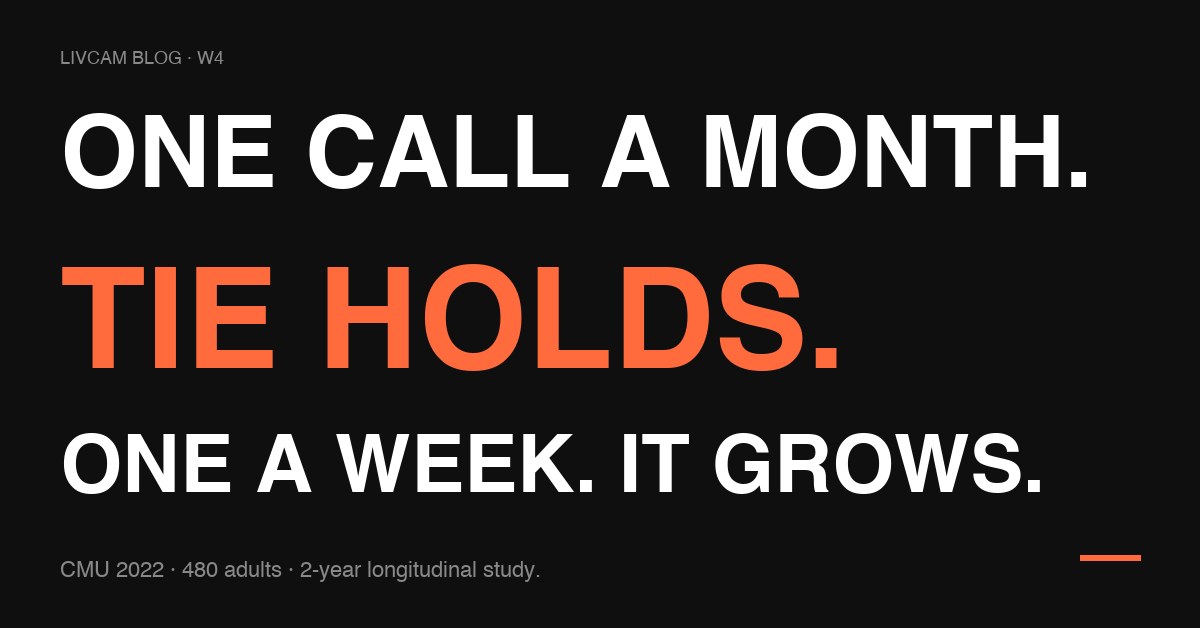
A 2022 longitudinal study from Carnegie Mellon tracked 480 adults across two years of remote friendships. Pairs who maintained at least one synchronous video or audio call per month sustained intimacy scores nearly twice those of pairs who exchanged only text. The study put the threshold for "tie holds" at one call a month, and the threshold for "tie thickens" at roughly one call a week. Both numbers are lower than most people guess.
Quick FAQ
What if my friend lives in a very different time zone?
Pick a slot that is mildly inconvenient for both of you. The mild inconvenience is what makes it stick. Easy slots get sacrificed first when life gets busy.
What if we run out of things to talk about?
Hang up early. Try again next week. A short awkward call this week is better than a long forced one. The reflex you are building is the call itself, not the content.
How do I bring this up without making it weird?
Send one message: "I want to actually keep in touch with you. Can we do a fifteen minute call once a week, Tuesday at 9?" Most people respond well to a clear ask, especially when the time commitment is small.
The friend you still have in 2031 is the one you put on the calendar in 2026. Fifteen minutes, once a week, one specific person. Start the habit on LivCam.