

The Rise of 1-on-1 Social Apps: Why People Are Choosing Conversations Over Feeds

For years, the internet has rewarded our attention more than our participation.
Open almost any social platform today and you'll find an endless stream of things to watch, read, react to, and share. The experience is polished enough that twenty minutes can disappear before you realize you've barely interacted with another person. You liked a clip of someone's dog, watched half a recipe you'll never cook, and typed nothing to anyone the entire time.
That isn't necessarily a flaw. Social media has become one of the world's most effective entertainment systems, and it continues to do exactly what it was designed to do.
What's interesting is what has started happening around it.
A growing number of people are downloading apps for a completely different reason. They're not looking for another personalized feed or another creator to follow. They're looking for a conversation—something an algorithm can't script in advance.
That change may seem subtle, but it reflects a much bigger shift in how people think about being social online. Instead of asking what they should watch next, more users are asking who they might meet next. It's one of the reasons 1-on-1 social apps have quietly become one of the fastest-growing categories in online communication.

The Feed Economy Isn't Disappearing—It's Simply No Longer Enough
The last fifteen years of social media have been defined by content.
Facebook encouraged people to share their lives. Instagram turned ordinary moments into visual stories. TikTok proved that a recommendation algorithm could be so effective that people would continue scrolling long after they intended to stop. Every major platform competed to deliver more engaging content, and for a long time, that competition shaped the entire industry.
Today, anyone with a smartphone has more to watch than any previous generation could get through in a lifetime.
But abundance creates its own challenges.
When every platform is competing for attention, users eventually begin asking a different question. Not "What else can I watch?" but "What else can I do?"
That second question is the one conversation-first platforms are built around. They aren't trying to replace social media. Instead, they offer something traditional feeds were never designed to provide: real-time interaction with someone you've never met before.
Conversations Create Something Content Can't
Think about the last conversation you genuinely enjoyed.
Chances are, you don't remember every sentence. What you probably remember is how it unfolded. A simple question led to an unexpected story. One shared interest opened the door to another. Before either of you noticed, the coffee had gone cold.
That's the nature of conversation. It isn't carefully edited or endlessly replayed. Its value comes from being unscripted.
Content works differently. Videos are recorded, edited, and pushed to millions of people. A conversation exists only because two individuals decide to participate in it together.
That difference explains why conversations leave a different kind of impression. They require curiosity instead of passive attention. They invite people to respond instead of simply react.
As more of digital life runs on automation, those qualities have become surprisingly valuable.
A New Category Is Taking Shape
The rise of 1-on-1 social apps isn't happening because people suddenly stopped enjoying social media. Most users continue to spend time on Instagram, TikTok, YouTube, or Snapchat every day.
What has changed is the role those platforms play.
People still visit them for entertainment, inspiration, or keeping up with friends. When they want to meet someone outside their existing circles, however, they open a different app.
That's where conversation-first platforms have found their place.
Some focus on language exchange, helping users practice with native speakers from around the world. Others connect people through shared hobbies or interests. Many make it easy to talk to strangers through live conversations that begin within seconds of opening the app.
Although the experiences differ, they all start from the same bet: that a person you haven't met is worth more of your evening than a feed that already knows what you like.
From Followers to Conversations
One of the biggest differences between traditional social media and 1-on-1 social apps is what success looks like.
On most social platforms, visibility matters. Profiles are built around followers, engagement, and public content. Whether you're an individual creator or a global brand, the experience encourages broadcasting.
Conversation-first platforms work almost in reverse.
The goal isn't to reach thousands of people. It's to have one meaningful interaction with one person.
There's no pressure to create videos every week or carefully curate an online identity. Many users don't even spend time browsing profiles before they begin talking. They simply match with someone, introduce themselves, and see where the conversation goes.
Removing the audience tends to make people less self-conscious. Without public reactions or performance metrics in play, there's no one left to perform for.
The Evolution of Social Platforms
| Era | Primary Behavior | Representative Platforms |
|---|---|---|
| 2005–2012 | Build your online identity | Facebook, MySpace |
| 2013–2018 | Share daily moments | Instagram, Snapchat |
| 2019–2024 | Consume personalized content | TikTok, YouTube Shorts |
| Today | Discover people through conversations | LivCam, Monkey, Azar, OmeTV |
Looking back, each row is really a different answer to the same question: what is the internet for this year? Conversation is the answer showing up now, and it hasn't displaced the earlier ones—Facebook and TikTok are still open in other tabs.
Why Are People Choosing Conversations Again?
Technology rarely moves in a straight line.
When social media first became popular, simply finding people online felt exciting. Then came the creator economy, where platforms rewarded those who could attract the most attention. Algorithms got better at guessing. The supply outgrew anyone's ability to keep up.
Ironically, the more connected the internet became, the easier it was to spend an evening online without actually talking to anyone.
This helps explain why conversation-first platforms have gained momentum. The complaint they answer is specific: you can finish an entire evening online having spoken to no one.
That doesn't mean social media is losing relevance. Content and conversation serve different purposes. You can watch a video badly and it still works. A conversation falls apart if only one person shows up.
You might watch four videos about Lisbon in a row, then suddenly want to ask someone what living there is actually like. Reading comments can only take you so far. At some point, curiosity becomes a conversation.
That's the moment conversation-first apps are built for.
Not All 1-on-1 Social Apps Are Trying to Do the Same Thing
Although they're often grouped together, today's 1-on-1 social apps serve different audiences and different goals. Some emphasize language exchange, while others focus on meeting people from different cultures or simply making casual conversations easier to start.
The diversity of the category is one of the reasons it continues to grow.
| Platform | Best For | Communication Style |
|---|---|---|
| LivCam | Instant conversations with people worldwide | 1-on-1 video chat |
| Azar | Cross-cultural communication | Video chat with translation features |
| Monkey | Casual social discovery | Quick video conversations |
| OmeTV | Random global conversations | Instant video matching |
| HelloTalk | Language learning | Text, voice, and language exchange |
What connects these platforms isn't a shared interface or identical features. It's the belief that meeting someone new can be valuable in itself.
Some conversations last only a few minutes. Others turn into language partners, or a standing Sunday call with someone in São Paulo. The outcome isn't guaranteed, but that's part of what makes the experience different from scrolling through content that has already been selected for you.
Why Is Social Discovery Becoming Its Own Category?
For years, online products were usually placed into familiar categories: social media, dating apps, messaging apps, forums, professional networking.
Conversation-first platforms don't fit neatly into any of them.
Most users aren't looking for romance. They're not trying to build a personal brand, either. In many cases, they simply want to meet someone outside their existing social circle, exchange ideas, or enjoy an interesting conversation with someone whose life looks completely different from their own.
This is why the term social discovery has become increasingly common across the industry.
Unlike traditional networking, social discovery isn't built around people you already know. Unlike dating apps, it isn't defined by romantic outcomes. Instead, it focuses on creating opportunities for unexpected human connection.
Expectations shape behavior, which is why the framing matters. When people join a platform expecting conversation rather than performance, the interaction often feels more relaxed from the very beginning.
The Next Generation of Social Apps Will Compete on Conversation Quality
The first generation of social platforms competed on user growth.
The second competed on content recommendations.
The next generation may compete on something far less visible: the quality of conversations they help create.
Matching technology is already becoming more sophisticated. Shared interests, preferred languages, time zones, and communication styles can all influence who people meet. At the same time, moderation tools continue to improve, making online conversations safer and more comfortable for users around the world.
Artificial intelligence will almost certainly play a larger role in this process—not by replacing human interaction, but by helping people find conversations they're more likely to enjoy.
Success, however, won't be measured by how long people keep scrolling.
It will be measured by whether they leave a conversation feeling that their time was well spent.
That is a very different definition of engagement.
Conversations Are Becoming a Destination, Not Just a Feature
For a long time, conversations existed as something that happened around content. People commented on posts, replied to stories, and reacted to videos.
Conversation itself is now the reason people open an app in the first place.
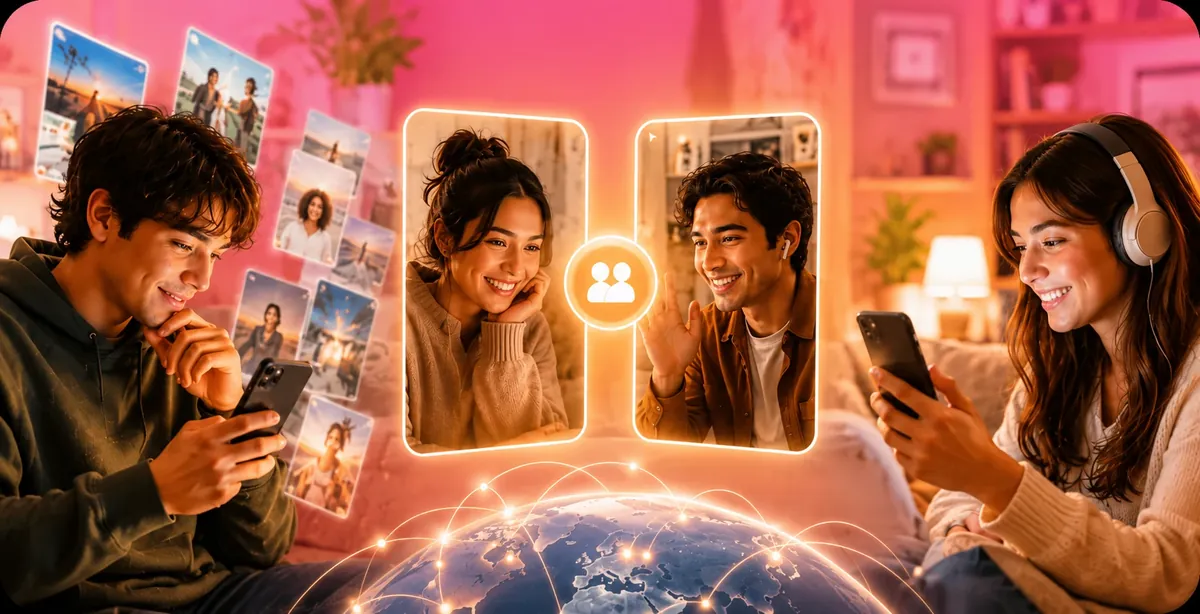
Platforms like LivCam reflect this broader shift. Instead of asking users to build an audience before they can interact with others, the experience begins with a conversation. A few taps are enough to start a 1-on-1 video chat, whether the goal is to meet new people online, exchange cultures, practice another language, or simply enjoy an unexpected discussion with someone on the other side of the world.
It's a simple idea, and it holds up better the more crowded the feed gets.
Sometimes the most memorable part of being online isn't another video that goes viral.
It's the person you never expected to meet.
Frequently Asked Questions
What are 1-on-1 social apps?
1-on-1 social apps are platforms designed to connect two people through real-time conversations. Unlike traditional social networks, the experience focuses on direct interaction rather than public content feeds or follower counts.
How are 1-on-1 social apps different from social media?
Traditional social media revolves around sharing and consuming content, while 1-on-1 social apps prioritize live conversations. Users typically join these platforms to meet new people, exchange ideas, or build genuine connections through voice or video chat.
Why are conversation-first platforms becoming more popular?
Many people enjoy social media for entertainment but also want opportunities for real interaction. Conversation-first platforms offer a more active and personal experience, making it easier to connect with people beyond existing social circles.
Are 1-on-1 social apps only for making friends?
No. People use these platforms for many different reasons, including cultural exchange, language practice, casual conversations, networking, and expanding their perspectives by meeting people from different backgrounds.
What makes LivCam different?
LivCam is designed around fast, natural conversations rather than endless scrolling. Its focus on random video chat and 1-on-1 video chat makes it easy for users to connect with people worldwide, creating opportunities for authentic conversations instead of passive content consumption.