

The Evolution of Online Communication: How We Went From Forums to 1-on-1 Video Chat (2005–2026)

If someone from 2005 opened a modern social app, they would probably recognize very little.
The way we communicate online has changed so dramatically over the past two decades that each generation has developed its own habits, expectations, and even its own definition of what it means to "talk" to someone.
There was a time when waiting ten minutes for a reply felt perfectly normal. Today, many people expect conversations to begin within seconds. Video calls that once seemed futuristic have become part of everyday life, while artificial intelligence now translates languages, filters harmful content, and quietly helps millions of people connect every day.
What's interesting isn't just how quickly technology has evolved.
It's how our expectations have evolved with it.
The story of online communication isn't simply a timeline of new platforms replacing old ones. It's the story of people constantly looking for better, faster, and more meaningful ways to connect with one another. Every major shift—from instant messaging to social media, from video calls to AI-powered communication—reflects a change in what users wanted at that moment in time.
Looking back at the last twenty years reveals something even more interesting.
Communication has become faster.
The internet has become larger.
Yet the conversations people value most are often becoming smaller, more personal, and more direct.
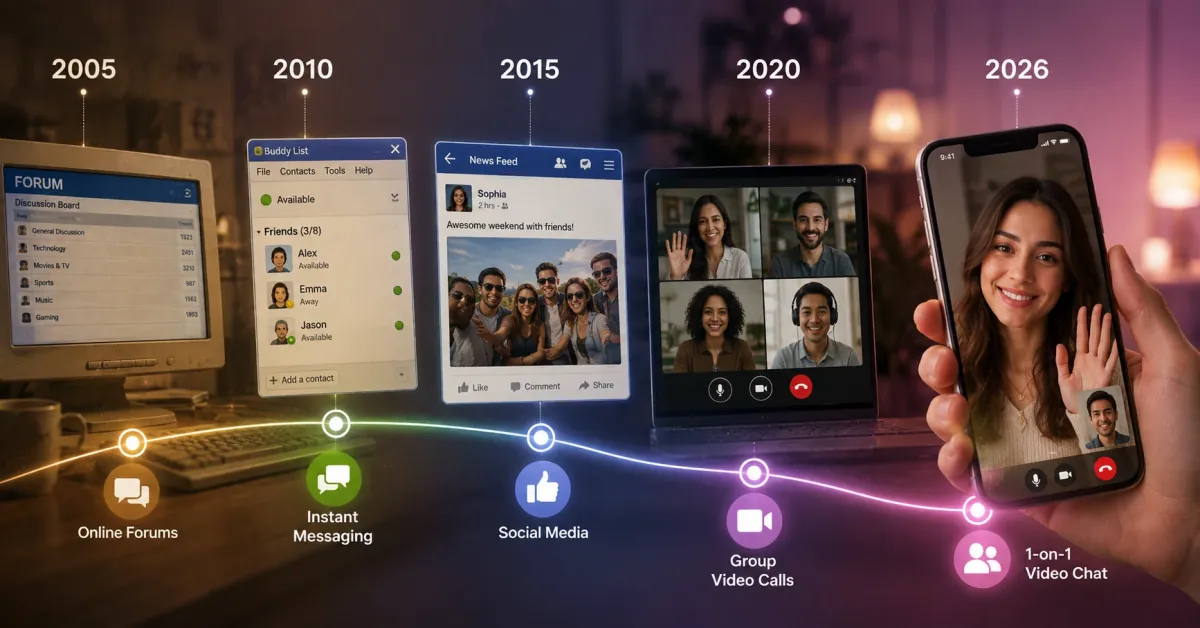
2005–2010: When Text Was Everything
In the mid-2000s, online communication was almost entirely built around text.
MSN Messenger, Yahoo Messenger, AOL Instant Messenger, internet forums, and IRC channels defined how people interacted online. Conversations happened one message at a time, usually on desktop computers, and there was little expectation that someone would always be available.
Waiting wasn't frustrating.
It was simply part of using the internet.
Forums also played a much bigger role than they do today. Instead of following influencers or creators, people joined communities built around shared interests. Photography enthusiasts gathered in one place, gamers in another, and travelers somewhere else. Conversations were often long, thoughtful, and surprisingly detailed because there was no pressure to respond immediately.
This period established one of the internet's most important ideas: geography no longer determined who you could talk to.
For the first time, someone in London could easily become friends with someone in Tokyo simply because they enjoyed the same hobby.
Looking back, that feels obvious.
At the time, it felt revolutionary.
2010–2015: Social Networks Changed Everything
The arrival of Facebook, Twitter, Instagram, and other social platforms transformed online communication in a completely different way.
People were no longer connecting only through private conversations.
They were sharing moments publicly.
Status updates replaced forum threads. Photos became conversations. Likes, comments, and shares introduced entirely new ways to communicate without saying very much at all.
This era also marked the beginning of everyday video communication. Apple introduced FaceTime alongside the iPhone 4 in 2010, making video calls dramatically easier and more accessible than before. While early adoption was gradual, it fundamentally changed expectations around what online communication could look like. For the first time, face-to-face conversations were only a tap away.
Identity also became central to the online experience.
Profiles evolved into digital versions of ourselves. Instead of simply talking with people, we were presenting ourselves to them. Photos, bios, follower counts, and timelines all became part of the conversation before anyone even sent a message.
Communication wasn't disappearing.
It was becoming more visual, more immediate, and increasingly centered around people rather than platforms.
2015–2020: Smartphones Made Communication Instant
The smartphone didn't invent online communication.
It removed almost every barrier to it.
Messaging apps such as WhatsApp, Messenger, Telegram, and WeChat made conversations continuous rather than occasional. Notifications meant people were reachable almost everywhere, and replying within minutes gradually became the new normal.
At the same time, communication became increasingly visual. Snapchat encouraged people to share everyday moments without worrying about permanence, while Instagram Stories shifted attention from carefully curated posts to content that felt immediate and authentic.
The internet was becoming less about websites and more about experiences that happened in real time.
People weren't waiting until they got home to communicate.
They were communicating wherever they happened to be.
2020–2022: Video Became Normal
Few events have influenced digital communication as dramatically as the global pandemic.
Almost overnight, millions of people who had rarely used video calls suddenly relied on them every day.
Business meetings moved to Zoom.
Families celebrated birthdays online.
Students attended classes remotely.
Friends who couldn't meet in person began catching up through screens instead.
Video communication stopped feeling like a special occasion.
It became routine.
Perhaps more importantly, many people realized that video could recreate something text never fully could: expressions, laughter, tone of voice, and all the small details that make conversations feel human.
The technology had existed for years.
The difference was that people finally became comfortable using it.
2023–2026: AI Quietly Changed the Way We Communicate
When ChatGPT became a household name, many people assumed artificial intelligence would change communication by replacing it.
Instead, something more practical happened.
AI began improving almost every step that happens before, during, and after a conversation.
Language translation became faster and more natural. Recommendation systems became better at introducing people with shared interests. Moderation tools started detecting harmful behavior more quickly, helping create safer online communities without interrupting ordinary users. Even accessibility improved as speech recognition and automatic captions became more accurate.
What's remarkable is that most of these changes happen quietly.
People rarely open an app because they want to experience artificial intelligence. They open it because they want to talk to someone, find information, or share an experience. AI simply removes many of the small barriers that once made those interactions slower or more difficult.
Rather than replacing conversations, it has made conversations easier to begin.
Communication Is Becoming More Personal Again
Looking back across the last twenty years, one pattern becomes surprisingly clear.
Technology has expanded our reach, but our most meaningful interactions have become increasingly personal.
The early internet connected communities.
Social media connected audiences.
Today, many people are looking to connect with individuals.
That shift has helped create a new category of products often described as social discovery. Instead of encouraging people to broadcast their lives to hundreds or thousands of followers, these platforms focus on introducing two people who might enjoy talking to each other.
The experience feels very different.
There is no pressure to post regularly, chase engagement, or build a personal brand. Instead, the value comes from what happens once the conversation starts.
Sometimes it's a five-minute chat with someone from another country.
Sometimes it's an hour-long discussion about music, travel, or football.
Sometimes it's simply a reminder that the internet can still surprise you.
The Rise of 1-on-1 Conversations
The growing popularity of 1-on-1 video chat isn't an accident.
It reflects a broader change in how people use the internet.
For years, online platforms encouraged users to consume more content. Every update introduced another feed, another recommendation engine, or another way to keep people scrolling.
Conversation-first platforms have taken a different approach.
Rather than asking users to spend more time watching, they encourage them to spend more time participating.
Instead of following creators, users meet people.
Instead of reacting to content, they exchange ideas.
Instead of building an audience, they build conversations.
This doesn't mean traditional social media is disappearing. Entertainment, news, and creator communities will remain an important part of online life. But they are no longer the only way people choose to spend their time.
Increasingly, conversation itself has become the destination.
A Timeline of How Online Communication Has Changed
| Period | How We Connected | What Changed |
|---|---|---|
| 2005–2010 | Forums, MSN Messenger, Yahoo Messenger | Text-based conversations connected people through shared interests. |
| 2010–2015 | Facebook, Twitter, Instagram, FaceTime | Public sharing and personal profiles became central to online interaction. |
| 2015–2020 | WhatsApp, Messenger, Snapchat | Smartphones made communication instant and mobile-first. |
| 2020–2022 | Zoom, Google Meet, Microsoft Teams | Video calls became part of everyday life for work, education, and personal relationships. |
| 2023–2026 | AI-powered communication tools | Translation, moderation, accessibility, and smarter matching improved online conversations. |
| Today | LivCam, Monkey, Azar, OmeTV | Conversation-first platforms make it easier to meet new people through live, real-time interactions. |
Where LivCam Fits Into This Story
Every stage in the evolution of online communication has solved a different problem.
Forums made it possible to meet people who shared your interests.
Social media helped us stay connected with existing friends.
Messaging apps made communication instant.
Video calls brought face-to-face interaction online.
Today, platforms like LivCam are building on everything that came before while focusing on a different goal: helping people discover new connections.
A conversation no longer depends on living in the same city, speaking the same language, or belonging to the same social circle. With modern live video chat technology, it's possible to meet someone from another part of the world within seconds and have a conversation that feels surprisingly natural.
Artificial intelligence helps make those introductions smoother through translation, smarter matching, and improved safety, but the conversation itself still belongs to the people involved.
That's an important distinction.
Technology creates the opportunity.
People create the connection.
What Comes Next?
Predicting the future of communication has never been easy.
Twenty years ago, few people imagined carrying high-definition video calls in their pockets. Ten years ago, real-time AI translation still felt experimental. Five years ago, few expected artificial intelligence to become part of everyday online communication.
The next decade will almost certainly introduce technologies we haven't considered yet.
Some will make conversations faster.
Some will make them safer.
Others will make it easier to communicate across languages and cultures.
But if the past twenty years have taught us anything, it's that technology succeeds when it removes friction rather than replacing people.
The platforms that shape the next generation of online communication are unlikely to be remembered simply because they introduced new features.
They'll be remembered because they helped people have better conversations.
Final Thoughts
The history of online communication is often described through the platforms that defined each era.
MSN Messenger.
Facebook.
WhatsApp.
Zoom.
ChatGPT.
Each one changed how people interacted in some way.
Yet the bigger story isn't about technology.
It's about expectations.
We've gone from waiting hours for a reply to expecting conversations to begin instantly. We've moved from desktop forums to mobile video calls, from local communities to global friendships, and from static profiles to real-time interactions.
The tools have changed dramatically.
The reason we use them has remained remarkably consistent.
People have always come online for one simple reason: to connect with other people.
Everything else has simply been a better way of making that happen.
Frequently Asked Questions
How has online communication changed since 2005?
Online communication has evolved from text-based messaging and forums to mobile messaging, social media, video calls, AI-powered tools, and conversation-first platforms that support real-time interaction.
Why is video communication more popular today?
Video allows people to communicate with facial expressions, tone of voice, and body language, creating a more natural experience than text alone.
What role does AI play in online communication?
AI improves online communication through language translation, smarter matching, moderation, accessibility features, and personalized recommendations. Its goal is to support conversations rather than replace them.
What are conversation-first platforms?
Conversation-first platforms focus on helping people connect directly through real-time interactions instead of content feeds. Many support random video chat, 1-on-1 video chat, and social discovery experiences.
How does LivCam fit into the evolution of online communication?
LivCam represents the latest stage of online communication by combining live video, global connectivity, AI-assisted features, and conversation-first design to help people meet and interact naturally across cultures and locations.